Case study · Order operations · 2026
The order desk that didn’t stop when one person went on leave
- Client
- Importer and distributor, Chennai
- Trade
- Industrial fasteners and zippers
- Onboarding
- One quarter, deployed incrementally
- Status
- Live since April 2026
The problem
Three people could receive an order. Only one could create one.
Two agencies sat behind the desk — one for bulk, one for loose and small-batch — with different billing rates and different tax identities. That meant two order templates maintained by hand, and a single incremental serial series that had to stay correct across both. The count lived in an Excel sheet and in her memory. She was also responsible for billing.
It was a single point of failure. A duplicate or skipped number was one distraction away, and when she was on leave the desk stopped.
What we built
Four updates over a quarter, each one earning the next.
Update 01
One system, not two templates
Both entities were modelled properly, the catalogue was written in, and order numbers were generated rather than remembered. From that point every order was created here. That alone removed the counter and the two-template problem.
Update 02
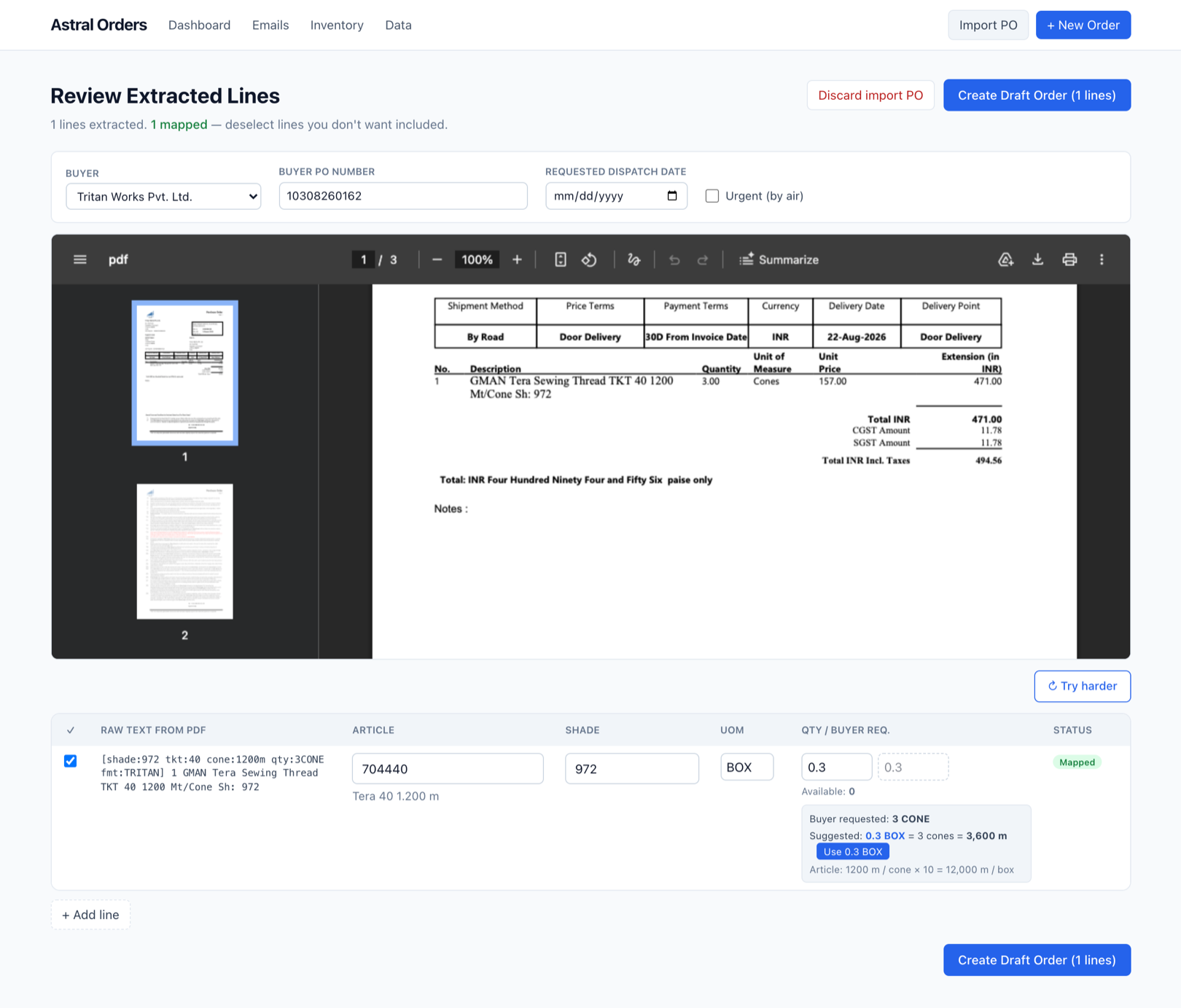
Reading the buyer’s PDF
Buyer orders arrive in varied formats, so parsers were built per buyer and entity type, resolving line items to catalogue article IDs — without sending anything to an external service. Fields stayed editable. The system proposes, the administrator confirms.
Update 03
Starting from the email
Orders could be raised from the buyer’s email directly, with no download step, which also closed off the chance of raising the same order twice. Supplier emails then went out through an in-system approval, so the sent order and its approval sit in one record.
Update 04
Inventory, once there was history
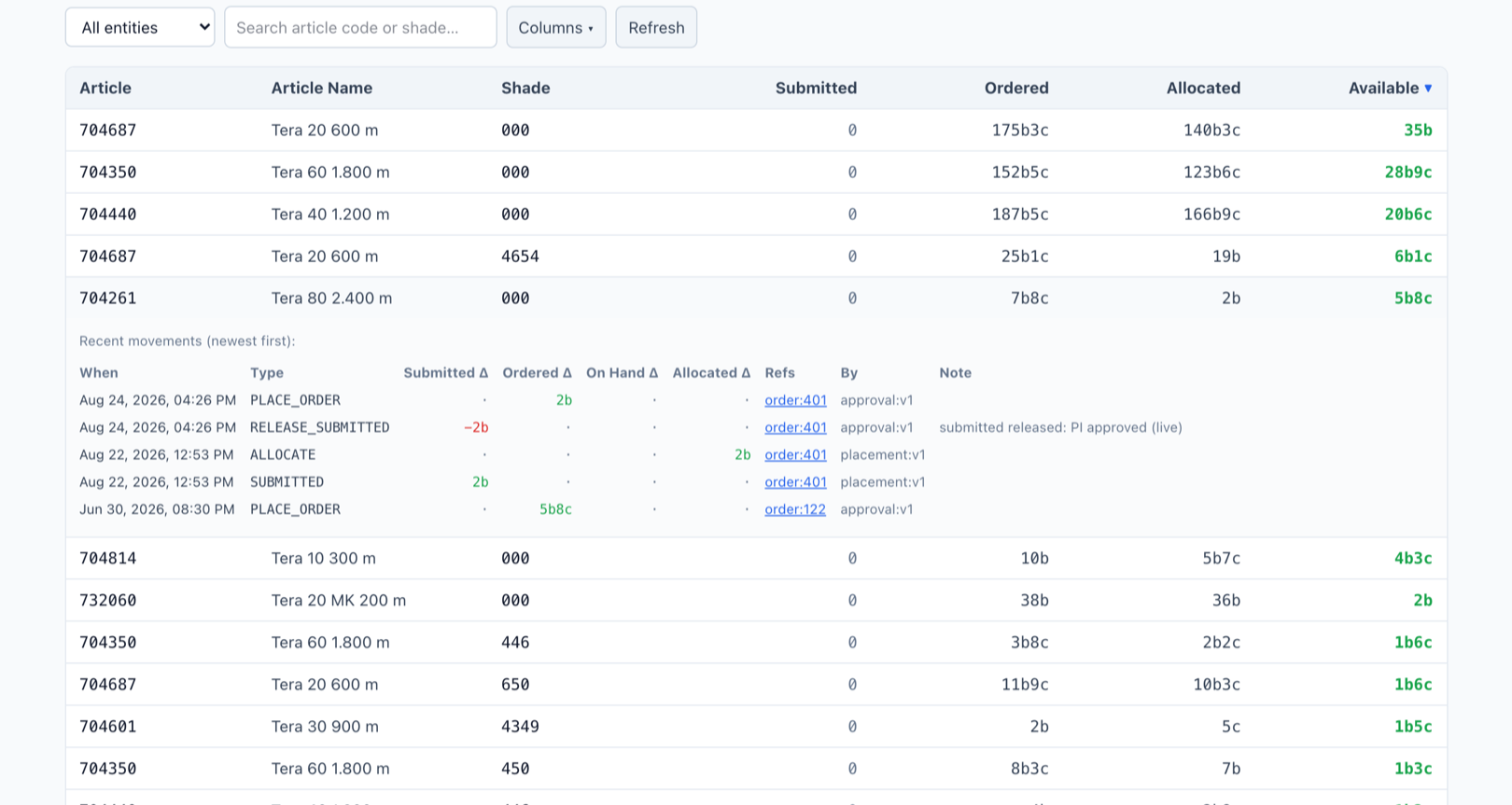
After two and a half months of orders, a tracker could compare what was ordered against what buyers had actually requested — exposing the excess held from minimum order quantities, and making that stock allocatable against new orders instead of ordering fresh every time. Each article became traceable both ways: to the buyer orders drawing on it, and the supplier orders filling it.
The result
The desk no longer depends on one person’s memory.
Everyone in the office sees the same dashboard, built around how this office actually works, and an order can be raised, traced and approved without holding two templates and a counter in your head. In practice she still runs it — but the business doesn’t halt when she isn’t there, and the decisions no longer carry the quiet cost of getting a number or an article wrong.
The system is still evolving. Each update earned the next.
Forty seconds of the same system in use, with no sound, is on the recording.
prashant@karailabs.comIf you have something like this to build.